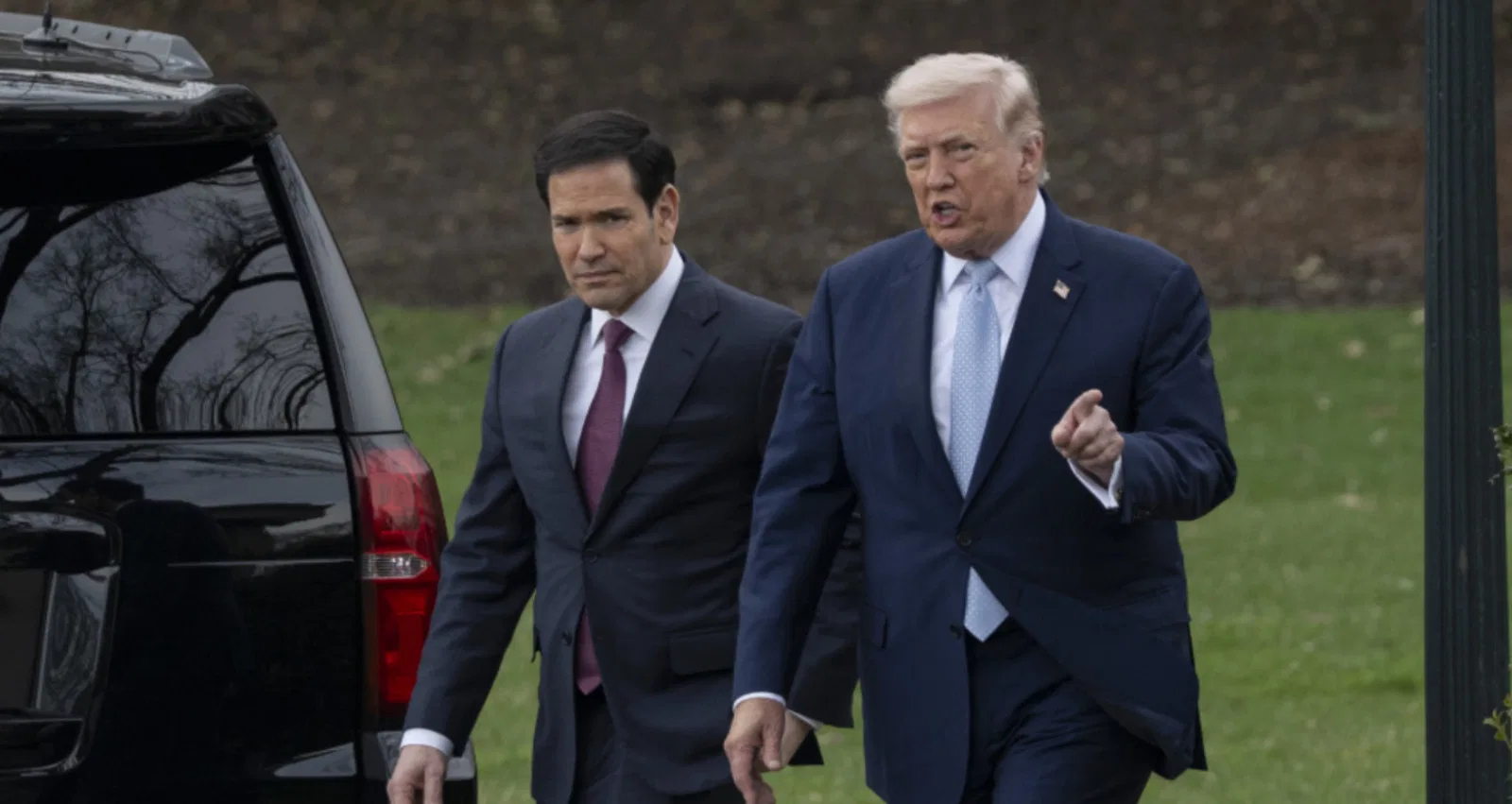
President Donald Trump said Thursday that he does not intend to deploy American ground troops into Iran, directly
countering anonymous reports suggesting his administration is weighing a major troop buildup in the Middle East.
During a bilateral Oval Office meeting with Japanese Prime Minister Sanae Takaichi, Trump was asked whether he planned
to lift sanctions on Iranian oil or send additional U.S. forces to the region.
“No, I’m not putting troops anywhere,” Trump said. “If I were, I certainly wouldn’t tell you, but I’m
not putting troops.”
His remarks came a day after a Reuters report, citing unnamed officials, claimed the administration was considering deploying
thousands of U.S. troops to reinforce operations in the Middle East.
The report suggested options under review included securing commercial tanker traffic through the Strait of Hormuz — potentially
requiring forces positioned along Iran’s shoreline.
The president’s comments represent the clearest public rejection yet of a ground invasion scenario, even as the Pentagon
confirms a visible expansion of U.S. military assets in the region.
An Amphibious Ready Group (ARG) and attached Marine Expeditionary Unit (MEU) totaling roughly 4,000 service members have been
ordered forward. Elements of the 31st MEU, based in Japan, and the amphibious assault ship USS Tripoli were
redirected toward the Middle East.
In addition, the Boxer Amphibious Ready Group — consisting of the USS Boxer, USS Portland, and USS Comstock
— is accelerating its deployment from the West Coast.
Together, these forces could expand to as many as six amphibious ships and approximately 8,000 total service members
in theater, including between 4,000 and 5,000 Marines. Defense Secretary Pete Hegseth approved the movement at the request
of U.S. Central Command.
Military officials emphasize that Marine Expeditionary Units are built for rapid, flexible response — not prolonged occupation. MEUs
include infantry battalions, aviation squadrons equipped with MV-22 Osprey tilt-rotors and F-35 fighter jets, logistics elements, and landing
craft. They are capable of embassy reinforcement, evacuation operations, maritime interdictions, targeted raids, and limited combat missions.
Such a deployment allows Washington to project power near the Strait of Hormuz without assembling the troop density
required for a large-scale ground invasion.
The strategic backdrop remains volatile. Since hostilities escalated in late February, Israel has targeted Iranian energy infrastructure, including
the country’s largest natural gas field, prompting retaliatory strikes across Gulf energy corridors. The Strait of Hormuz —
through which roughly one-fifth of the world’s oil supply transits — has emerged as a focal point of
global economic anxiety.
Trump acknowledged that military operations could temporarily disrupt markets but framed the action as necessary to neutralize what
he described as a long-term strategic threat.
“Everything was going great. The economy was great. Oil prices were very low,” Trump said, noting that the
Dow Jones Industrial Average had reached 50,000 and the S&P 500 7,000 before the current conflict. “And I
saw what was happening in Iran, and I said, ‘I hate to make this excursion, but we’re going
to have to do it.’”
He added that he expected oil prices and markets to react more sharply than they have so far
and suggested the operation would conclude relatively quickly.
“I thought there was a chance it could be much worse,” Trump said. “It’s not bad, and it’s
going to be over with pretty soon.”
While Trump has historically avoided ruling out options outright, his categorical rejection of ground troop deployment signals an
attempt to draw a distinction between deterrence and invasion. The administration appears to be pursuing a strategy centered
on naval dominance, airpower, special operations flexibility, and economic pressure — rather than regime-change through occupation.
For now, the operational posture reflects forward positioning and contingency planning. Amphibious forces provide options. Naval patrols secure
shipping lanes. Air assets deter escalation.
But according to the president, American boots will not be marching into Iran.