President Donald Trump said Monday that he does not plan to sign additional legislation until Congress passes a proof-of-citizenship voting measure that he supports.
President Donald Trump said Monday that he does
President Donald Trump said Monday that he does not plan to sign additional legislation until Congress passes a proof-of-citizenship voting measure that he supports.
Speaking to House Republicans during their annual retreat at his golf club in Florida, Trump said he believes stricter voting requirements are necessary to prevent fraud and ensure election integrity ahead of the upcoming midterm elections. He also called for ending widespread use of mail-in voting.
Trump is backing the Safeguard American Voter Eligibility Act, which has already been approved by the House. He urged the Senate to move the legislation forward despite the chamber’s filibuster rules.
Supporters of the bill say requiring proof of citizenship would strengthen election security. Critics argue the proposal could make voting more difficult for some eligible voters who may not have immediate access to documents such as birth certificates or passports. They have also raised concerns about restrictions on mail-in voting, which is widely used in several states.
“I’m not going to sign anything until this is approved,” Trump said, adding it is his No. 1 priority.
“It’ll guarantee the midterms,” he said. “If you don’t get it, big trouble.”
Nearly all Democrats in Congress oppose the legislation
Nearly all Democrats in Congress oppose the legislation, though some 85 percent of Americans, and 70 percent of Democrat voters, support having to show an ID to vote.
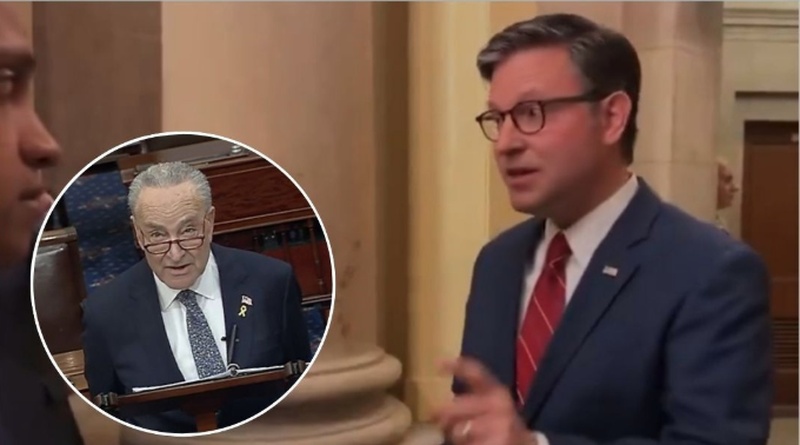
House Speaker Mike Johnson, who has a strong relationship with Trump, appeared on stage with the president and other GOP leaders to applaud the bill. However, Senate Majority Leader John Thune has noted that using the so-called “talking filibuster” to pass the voting bill, as proposed by Trump and others, is not as straightforward as it may seem, The Associated Press reported.
“We can’t find a piece of legislation in history that’s been passed that way,” Thune told reporters earlier this week.
Under the version of the bill already approved by the House, voters would be required to provide proof of citizenship — such as a passport or birth certificate — when registering to vote. The measure would also require voters to present a photo identification when casting a ballot, a requirement already in place in many states.
Trump has said he would seek to add a provision prohibiting widespread use of mail-in ballots, while allowing limited exceptions for voters who are disabled, serving in the military, or facing other special circumstances.
Trump has argued that mail-in voting increases the risk of fraud. Other experts have agreed, noting that voter registration rolls are historically inadequate and that mail-in ballots are sent to names associated with addresses where they may have moved, died, or no longer live, allowing the current occupants to vote.
The president has also suggested adding provisions
The president has also suggested adding provisions related to transgender policies, including one that would prohibit transgender women from competing in women’s sports and another that would restrict certain gender-transition medical procedures for minors.
In addition, Trump raised the possibility of attaching a separate measure related to the Foreign Intelligence Surveillance Act, which is currently up for reauthorization and has historically prompted significant debate in Congress, The AP added.
“Let’s go for the gold,” he told the House Republicans at his resort in Doral.
A coalition of supporters aligned with Trump has advocated for versions of the Safeguard American Voter Eligibility Act, with proof-of-citizenship requirements representing a longstanding priority among many in the president’s political base. Trump told House Republicans that the current version of the bill does not go far enough, warning that he would not sign what he described as a “watered-down” version of the legislation.
Republican senators are expected to discuss possible next steps during private meetings this week. At this stage, there is no clear consensus within the conference. Some lawmakers favor attempting to advance the bill by forcing a talking filibuster, while others oppose that strategy.
Thune has cautioned that allowing extended debate under a talking filibuster could also open the legislation to a large number of amendments, potentially altering the bill in ways that could divide GOP support.